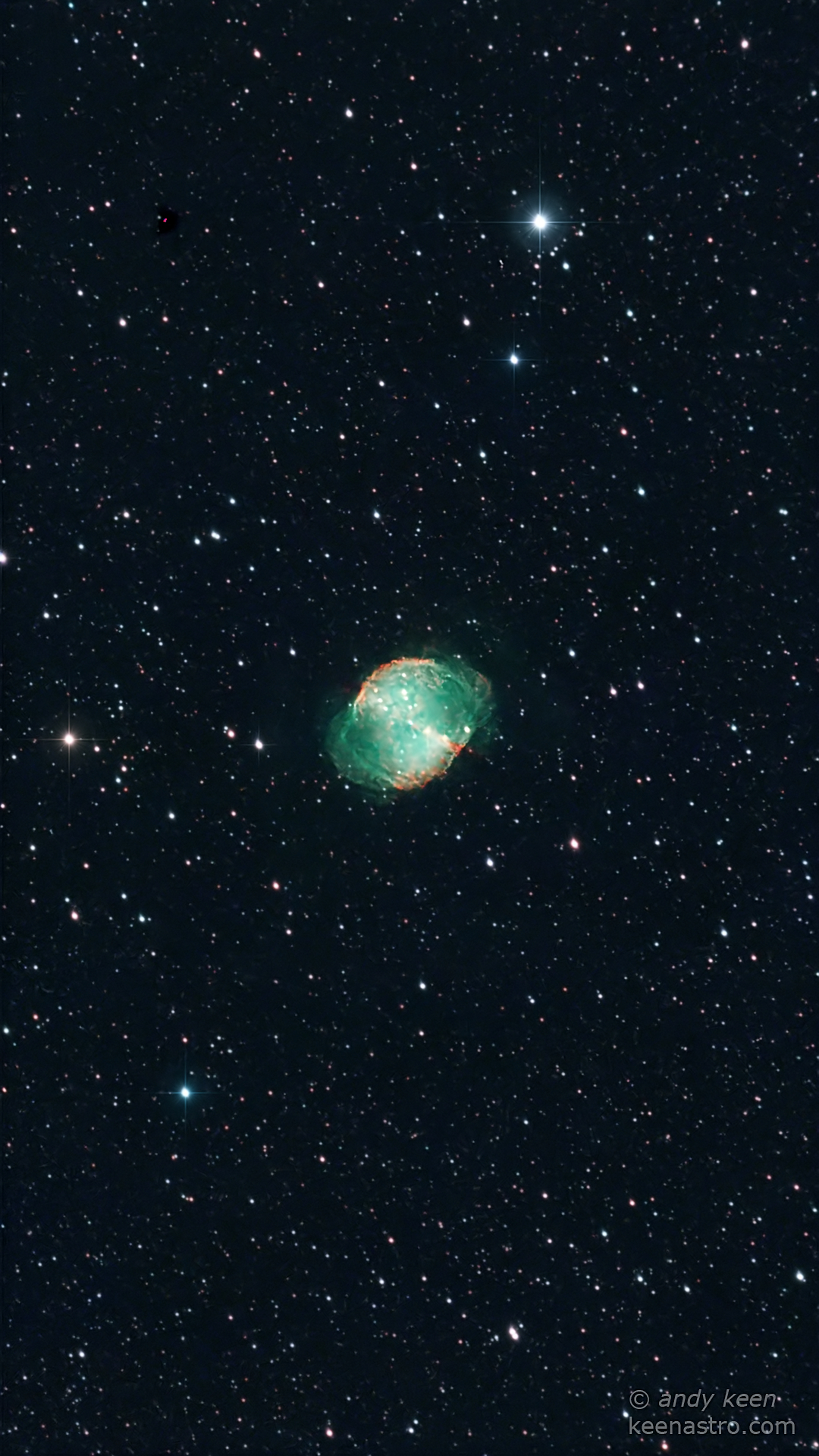
Chasing the Dumbbell Nebula with the Seestar S50
On the night of 14 July 2025, I pointed the Seestar S50 at one of the sky’s more recognisable planetary nebulae, Messier 27, also known as the Dumbbell Nebula. Sitting in the constellation Vulpecula, it has always stood out to me for its distinctive shape and brightness. Even in less-than-perfect skies, it makes itself known.
I ran the Seestar in EQ mode and collected 221 subframes, each one 20 seconds long. The sky was Bortle 5, so I wasn’t expecting anything extraordinary, but the result turned out better than I’d hoped. After stacking the data using WBPP in PixInsight, I took care of the bulk of the processing there before moving to Photoshop for the finishing work.
In Photoshop, I fine-tuned the black point and highlights, cleaned up the noise a little, and added a gentle touch of StarSpikes Pro to lift the brighter stars. Just enough to make them pop without going overboard.
What I enjoy about imaging M27 is that it doesn’t ask for hours of exposure time. Even with a relatively short session, you start to see the expanding structure and finer detail emerging. It’s the kind of object you can come back to again and again and still find something new in the data.
It was a satisfying capture, both in terms of the result and the experience. The Seestar handled it well, and the Dumbbell continues to be one of those deep sky targets that never disappoints.